
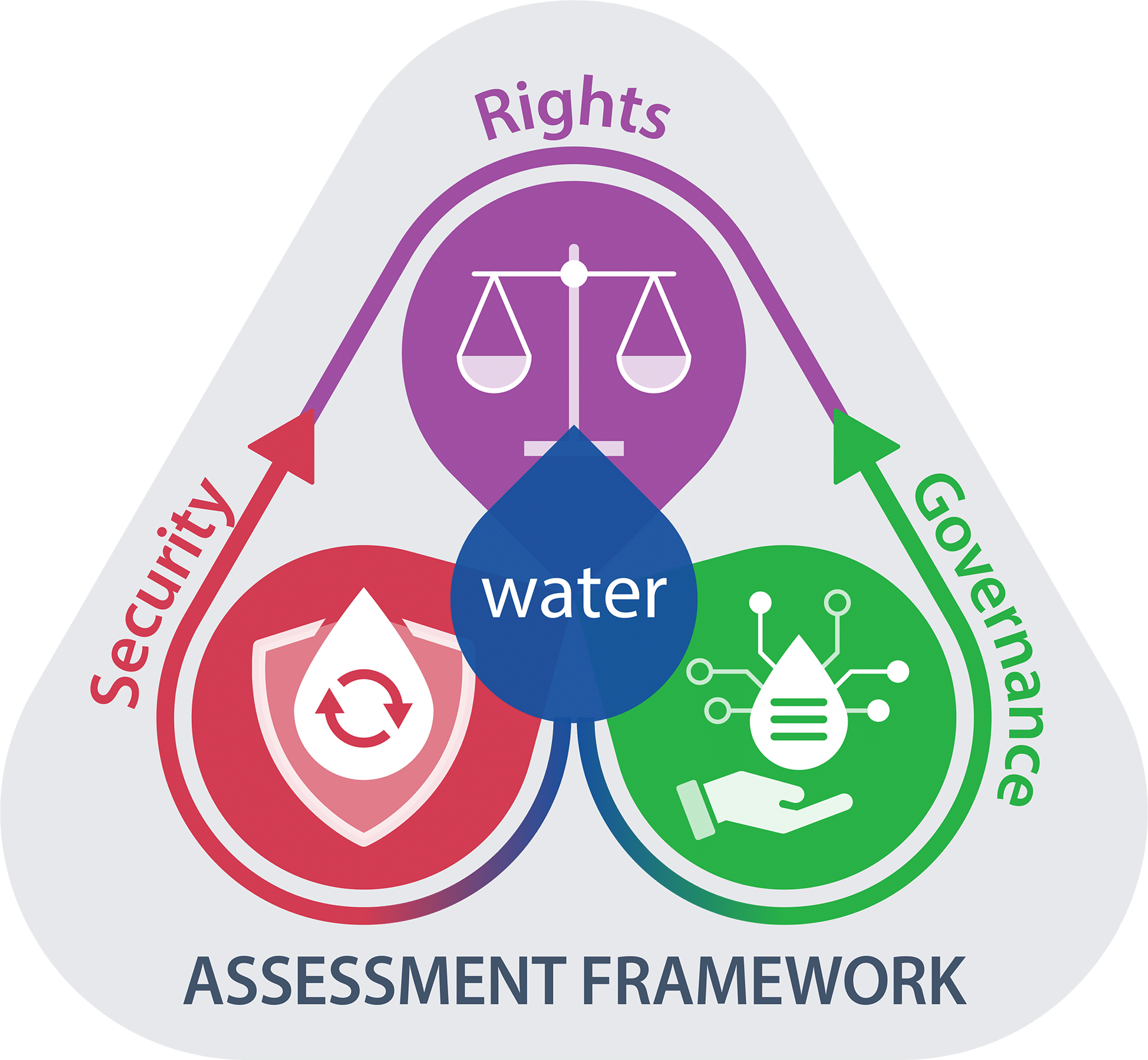
Exploring the Realizing Rights for Water Framework

team bilding
A

Water Security Assessment: Collect information on the relationships between environmental conditions, industrial processes, and impacted communities

B

Water Governance Assessment: Collect information on national and local governance structures, key actors, past conflicts, decision-making power, and other social aspects

C

Human Rights Responsibilities Assessment: Produce targeted human rights questions that relate to identified water security and governance concerns

About Our Framework

The Realizing Rights for Water Framework is a three-step human rights risk assessment that brings together water catchment concerns, local governance and historical factors, and national and international regulations to produce a series of tailored legal inquiries for actors to incorporate into their pre-project implementation protocols and periodic reviews.

Our framework flips the script. It aims to help water-intensive industry actors ask the right questions rather than prescribe standardized answers. Ultimately, the Realizing Rights for Water Framework elevates human rights to become a core part of how water-intensive industry actors design and implement their water management strategies.

Water Security Analysis
Water Governance
Human Rights Responsibilities
graphic_framework-only
Overview

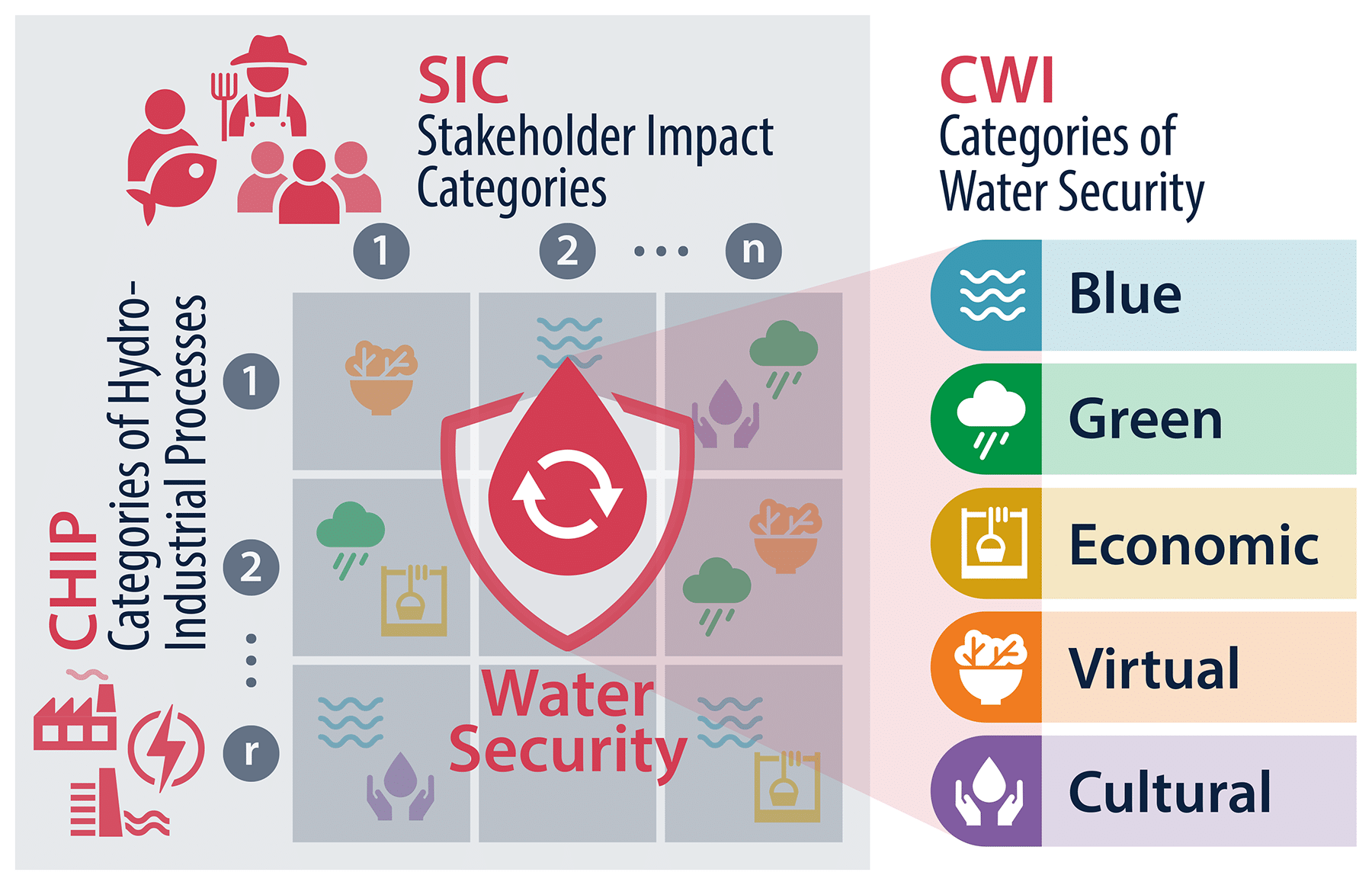
Our framework begins with a water security analysis of the catchment area. The assessment identifies any potential hydrological disturbances (insecurities) associated with a given project and their effect on the water-related social, ecological and economic services relied upon by communities.
graphic_security
Components

Each hydrological insecurity is categorized as one of five water types. “Blue” water insecurity encompasses threats to surface water availability. “Green” water insecurity involves threats to rainfall. “Economic” water insecurity emerges when blue water is needed and present but requires a missing type of infrastructure to appropriately use it (such as pumps or treatment facilities). “Virtual” water insecurity arises in cases where other present forms of water insecurity cannot be substituted by trade imports (such as importing food when blue water scarcity threatens farming). Finally, “cultural” water insecurity emerges in cases where a community’s cultural or spiritual relationship to water or associated activities and services cannot be sustained after the hydrological disturbance.

graphic_framework-only
Overview

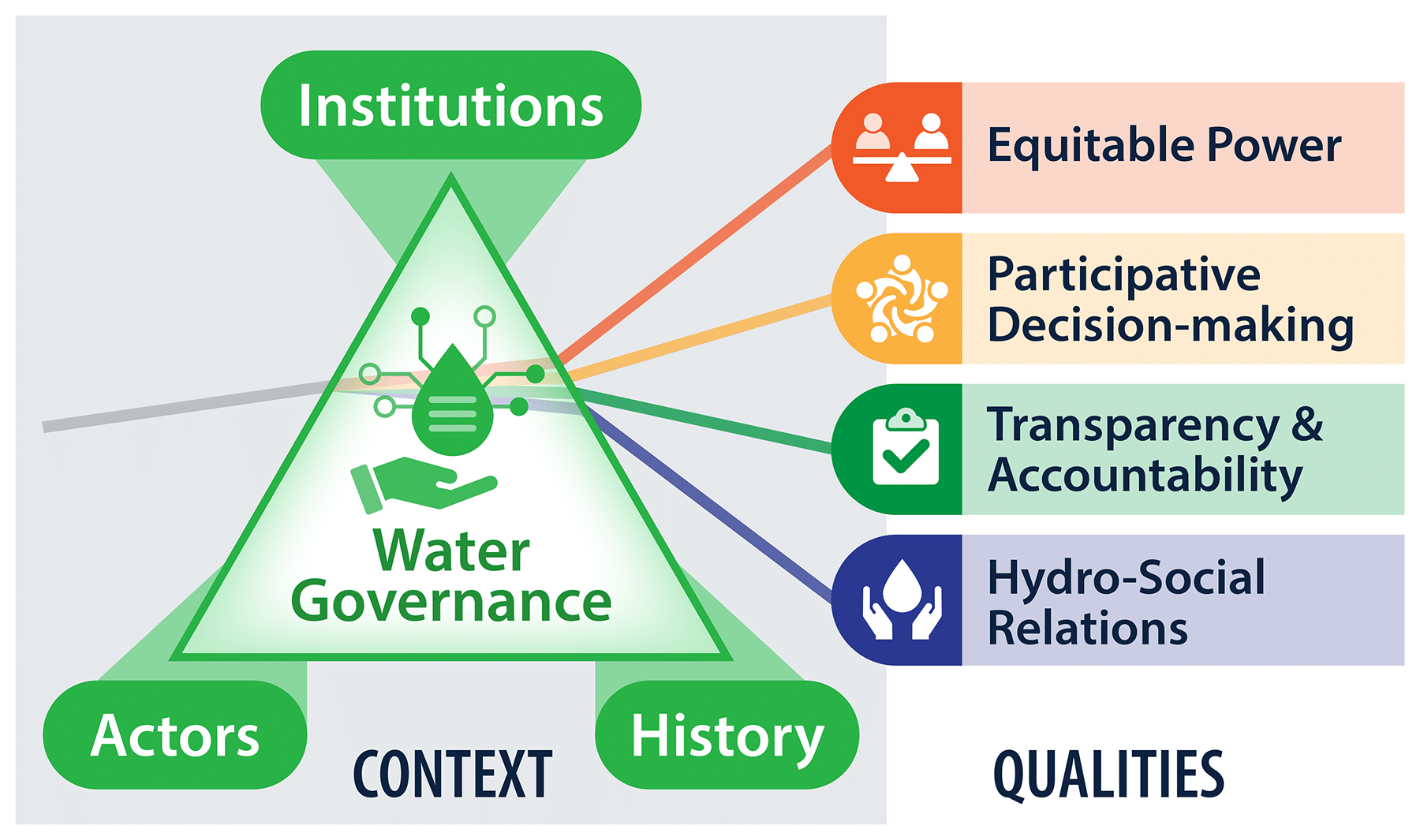
Following the water security assessment, our framework next explores the extent of governance failure and institutional weaknesses that have implications for the human right to water for any future or ongoing project.
graphic_governance
Components

The framework first establishes the institutions that manage and allocate water, the key actors affecting water within the catchment area, and any history of preexisting grievances that might influence perceptions of water decisions. Then, the framework interrogates whether the following four factors are present: equitable power, participative decision-making, transparency and accountability, and maintained community hydro-social relations.

graphic_framework-only
Overview

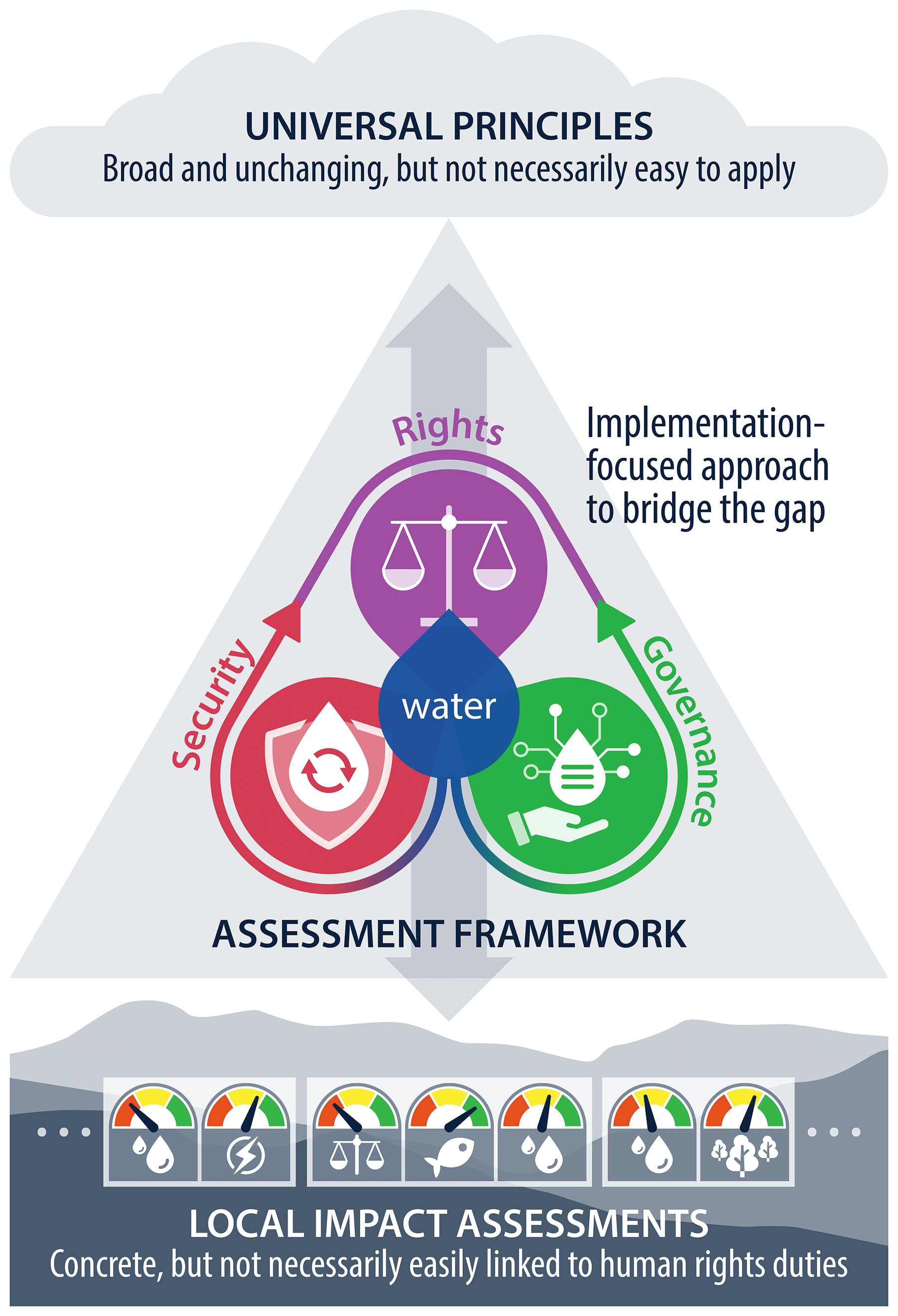
The final step of the framework is to form targeted human rights legal inquiries from the water security concerns and governance concerns raised during the first two parts of the assessment. The assessment does so by first laying down a structured articulation of the qualities of the human right to water and then asking, for each concern raised, whether the qualities of the human right to water are respected while also respecting cross-cutting obligations and interrelated rights.
graphic_framework
Components

The legal analysis examines each water security and governance concern through the lens of whether it impacts the human right to water. The analysis then forms targeted legal questions in response to any potential overlap, which can then be embedded into broader project assessment procedures.

Framework Screening Process

Lorem ipsum dolor sit amet consectetur. Elit sit sed condimentum sit. Feugiat risus condimentum pharetra nulla. Tortor sem sit vitae tellus. Nunc sollicitudin facilisis aliquet sollicitudin dignissim. Integer erat quis pellentesque urna ac lorem enim senectus cras.

Frequently Asked Questions (FAQs)

Still have questions? Learn more about our project below.

Who should use our framework?
  • Our primary audience is those within water-intensive sectors who make decisions on water management and/or influence overall project implementation. Depending on the sector and context, these actors may belong to a private firm, an enterprise implementing a state-owned project, or a government agency funding or managing the project.

  • Community leadership may also find value in our framework. They may use our framework to form human rights inquiries independent from the project assessment and use the results to push for greater accountability and transparency from the implementing actor. They may also use the framework when negotiating and approving projects that take place within their communities.
From where does our framework derive its approach?
  • Our framework does not recreate the wheel. Each part of the assessment incorporates best practices from the respective disciplines. Our innovation lies in how we have blended the fields together to produce the most comprehensive, 360-degree view of socio-hydrological threats.

  • The water security assessment tool merges established paradigms of green, virtual, and blue water security (Mekonnen and Hoekstra 2011; Hoekstra and Hung 2002) and emerging paradigms of economic water scarcity and hydrosocial cycles (Rosa et al. 2020); Linton and Budds 2014).

  • The governance assessment brings together core features of OECD water management principles, the Integrated Water Resource Management Framework (IWRM), principles articulated in academic literature (such as Rogers and Hall 2003), and United Nations indicators.

  • The legal assessment draws on extensive legal formation of what constitutes the human right to water, which is outlined in Annex A of the Framework but most notably includes the prominent AAAQ (availability, accessibility, acceptability, and quality) framework.
When should our framework be implemented?
Our framework is best implemented as a risk assessment tool used proactively in tandem with other pre-project assessments. Though the framework can be applied throughout a project timeline to examine potential human rights concerns, the framework is most effective when decision-makers leverage it as a preventative strategy for shaping a project around respecting human rights.
Does our framework determine human rights violations?
The framework does not assign direct responsibility for human rights violations. It stops short of determining whether specific legal statutes have been violated and whether such violations have been caused by specific actors. To assign responsibility goes against the framework’s preventative rather than retributive aspirations. Casual attributions are also difficult to standardize due to the complex nature of most socio-environmental systems.

We never aim to work in isolation.
Explore how our framework responds to and augments preexisting best practices for water stewardship