

Background
Tiruppur, a city located in the Indian state of Tamil Nadu, is a major center for cotton knitwear production. The city currently contributes around 90% of total cotton knitwear exports from India according to the Tiruppur Exporters’ Association (TEA, 2023) and has contributed significantly to the economic growth of the region by employing a large number of workers from the local population. Tirupur is a prominent supplier for several leading clothing companies, including Nike, Cutter & Buck, Tommy Hilfiger, Fruit of the Looms, Adidas, GAP, Fila, Arrow, TESCO, S Oliver, Inditex (Zara), US Polo, and many others. It also supplies major chain stores such as C&A, Walmart, Target, Primark, Sears, and H&M. This shows Tirupur's importance in the worldwide textile and clothing sector, as well as its considerable contribution to the country's economy through exports (See more at https://tea-india.org/about-tea). However, the production process also has created critical environmental externalities over the years, including over-exploitation, waste generation, and chemical effluents.

The cotton knitwear production of Tiruppur pollutes the Noyyal River, which flows eastward through the city and provides water to 243 villages and 86 urban settlements in the districts of Coimbatore, Tiruppur, Erode, and Karur (Census of India, 2011). The Noyyal River was once a perennial river but has since become a seasonal river with flows mostly during two separate monsoon seasons (Karunanidhi et al. 2022).
From the 1980s until 2011, before the enforcement of a Zero Liquid Discharge (ZLD) policy, the bleaching and dyeing units in the region generated a substantial volume of wastewater and released them into the river without sufficient treatment. The dumping subsequently contaminated the region's surface water, groundwater, and soil because it contained high levels of chemicals and other pollutants, such as dyes, bleaches, and detergents, which harmed the river's ecosystem and the health of people who rely on it for drinking water and irrigation (Yuvasakthi and Kumar, 2017). Many farming families upstream and midstream of the river also faced groundwater depletion as a result of pumping by water-intensive industries.
Previously, the untreated wastewater and toxic effluents discharged from the textile industry into the Noyyal River used to accumulate in the Orathupalayam dam. The dam was constructed in 1992 to store flood waters of the Noyyal and irrigate around 500 acres in Erode district and 10,375 acres in the Karur district by a feeder canal to the downstream Aathupalayam reservoir (Srinivasan et al., 2014). However, in 1997, due to the industrial waste that contains chemicals, heavy metals, and unpleasant odors, the dam was converted into effluent storage after only 5 years of operation and was no longer utilized as a source of irrigation. In 2005, a heavy rainstorm caused flash floods that resulted in the overflowing of more than ten years of stagnant effluents from the Orathupalayam dam and released over a half million cubic feet of toxic effluents and 400 tonnes of dead fish into the river (Srinivasan et al., 2014). Later, research revealed that the reservoir contains heavy metals such as chromium, copper, zinc, and lead (Apoorva et al., 2019). At the request of the very farmers who were supposed to benefit from the dam, the Orathupalayam dam was deactivated.
The Loss of Ecology (Prevention and Payments of Compensation) Authority estimated that soil and water pollution over the years impacted over 28,500 farmers, many of whom were small and marginal farmers that had been in the region for centuries (see M.Ramasamy vs The Chief Secretary on 1 November, 2012 for more details). By 2007, only 38.5% of available farmland remained viable for normal cultivation. Fish populations also plummeted or became inedible, which impacted the numerous subsistence farmers living in the area (Appasamy and Nelliyat, 2007). The TEA and the Tirupur Dyeing Factory Owners Association, the main representatives from the bleaching and dyeing industry, were apathetic to protests from the community (Janakarajan, 1999).
Starting in 1996, farmers' associations began filing petitions with the High Madras Court with the aim of using the court system to convince the responsible government entity, the Tamil Nadu Pollution Control Board (TNPCB), to enforce pre-existing pollution policies and to secure compensation for the farmers’ losses (Srinivasan et al. 2014). This began a series of court hearings that would result in favorable rulings for the farmers’ associations but lead to no behavior change on the part of the textile units unless the court ordered a halt in production. The TNPCB particularly struggled to enforce court orders for the establishment of individual and common effluent treatment plants (IETPs and CETPs) and the order for the establishment of zero liquid discharge (ZLD) plants after it was discovered that IETPs and CETPs still led to the dumping of extracted waste (Apoorva et al., 2019). Despite extensions, the units failed to comply, leading to the court's 2011 order to shut down all textile dyeing and bleaching units in the Tiruppur district. The state government then established a monitoring committee to ensure compliance. The committee gave a 3-month deadline to industries to comply with the order, following which some textile units adopted zero liquid discharge technology and resumed operations, while the remaining units were permanently closed (Apoorva et al., 2019).
Water Security Analysis
The Madras School of Economics (2002) classified the Noyyal Basin into four zones according to their location along the river; the upstream riverside (Zone 1), where people used river water for drinking, was considered the least contaminated region. The midstream Zone 2 was primarily impacted by Coimbatore's domestic sewage, as well as some level of industrial pollution. The Siruvani and Pillur schemes provided the majority of domestic water by transporting water from neighboring Nilgiris area and Bhavani basin. Areas with no piped water supply consumed groundwater for drinking. Zone 3 was the most impacted midstream area by industrial pollution. Zone 4 originally experienced fewer impacts thanks to the containment of effluents at the Orathupalayam dam. However, as mentioned above, the 2005 Orathupalayam dam overflow eventually contaminated this downstream ecosystem. Three categories of hydro-industrial processes (CHIPs) operated in this region:
- River Pollution from Textile Effluent: Textile industry-related pollution in the Noyyal River had a negative influence on communities and farmers through contaminated water sources, reduced crop yields, and health risks.
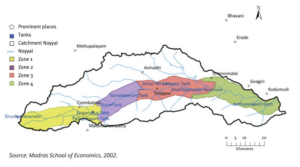
- Groundwater Extraction: The Noyyal Basin textile sector heavily used groundwater for dyeing, bleaching, and finishing procedures. Excessive extraction affected over half of the basin, resulting in a major decline in groundwater levels, which initially caused water scarcity for households and economic water constraints for farmers.
- Groundwater Pollution: Groundwater contamination rose as a variety of chemical components seeped into the soil, particularly in built reservoir tanks and behind anicut dams along the river. These seeping pollutants adversely affected public health and reduced crop productivity, resulting in economic water insecurity for households and farmers.

Three main Stakeholder Impact Categories (SICs) can be identified in this region:
- Domestic Water Users: Many families along the Noyyal River used its water for basic household needs: laundry, bathing, washing dishes, and occasionally drinking.
- Midstream Farmers and Fishermen: Before 2011, farmers in the midstream section of the Noyyal River depended on the reliable irrigation from groundwater and (to a smaller extent) surface water from the Noyyal River. Fishermen used the river for subsistence fishing.
- Dam Irrigated Farmers: These farmers used to irrigate their fields from the water passing through the Orathupalayam dam. However, the 2005 overflow of the dam polluted the agricultural lands of downstream farmers, causing many to abandon their agricultural activities.
River Pollution from Textile Effluent
Textile production consumes a large amount of water while simultaneously discharging substantial volumes of effluent during the manufacturing process. Once the effluent is discharged into the river, it mixes with the river water and begins to spread downstream. As the effluent moves downstream, pollutants enter the river's ecosystem and contaminate plants and other organisms that depend on the river for their survival. Overall, effluent pollution of the river affected SICs in the following way:
On domestic water users
According to Apoorva et al., (2019), the total urban and rural domestic demand in the basin was about ~440 million liters per day (MLPD). The New Tirupur Area Development Corporation Limited (NTADCL) project, completed in 2006, imported around 185 MLPD from the downstream Cauvery-Bhavani confluence for Tiruppur City and its surrounding villages. The Siruvani and Pillur schemes supplied water from the Nilgiris area and Bhavani basin to Coimbatore city and some villages. In addition, Tamil Nadu Water and Drainage Board (TWAD) provided bulk water to municipalities and Town Panchayats (TPs) via various schemes (Srinivasan et al., 2014). Villages without piped water consumed groundwater via borewells installed by national and state funds.
In some villages, the rural population along the Noyyal River used Noyyal water for basic household needs, such as laundry, cleaning, bathing, washing dishes, and even drinking. Water used for domestic purposes in these affected areas became extremely contaminated and produced several negative health effects. Several researchers documented a rise in skin diseases and viral lung infections (Govindarajalu, 2003). Researchers (Pranaw, 2014; Subramanian & Baskar, 2022) later concluded that while the upstream river was drinkable without treatment, water from the downstream could not be used for drinking. To sum up, if observing conditions in 2011 (which were consistent, if not worse, than recent studies), the situation induced economic water insecurity for the midstream and downstream communities that used water for household chores directly from the Noyyal River. In addition, river pollution caused cultural water insecurity because the Noyyal River was historically considered a sacred river of the region but had now turned into a “dead river” (Subramanian & Baskar, 2022).
On midstream farmers and fishermen
In the past, farmers in the area would irrigate lands with water from the Noyyal River to cultivate a diverse range of crops such as rice, sugarcane, groundnut, sesame, turmeric, beetroot, green chili, tomato, cotton, tobacco, and several vegetables on their farms before the dyeing pollutants began to impact their crops in the mid-1990s (Deshpande, 2020). With the textile manufacturing boom, the discharged effluents spread onto agricultural lands and degraded the soil's physical and chemical characteristics. The farmlands eventually could only support a limited variety of crops, primarily maize for dairy and livestock farming, sorghum, and coconut (Yuvasakthi and Kumar, 2017). This shift posed virtual water insecurity for farmers, who suffered reduced earnings from the region's economic and ecological transformation. Fishermen were also affected due to a significant decrease in the fish population. By 2011, some parts of the river had no fish species at all. Furthermore, economic water scarcity arose due to the inefficiency or lack of water treatment plants, which could clean water for irrigation purposes. Indeed, by 2011, only a small amount of land was being irrigated through the surface water of the Noyyal River.
On dam-irrigated farmers
Due to the continuous accumulation of untreated and partially treated industrial effluents at the Orathupalayam Dam before 2005, the effluent-mixed water threatened drinking and irrigation purposes. While midstream farmers demanded the release of effluents from the dam to avoid groundwater contamination, downstream dam-irrigated farmers opposed this as they did not want to bear the negative effects (Venkatachalam 2015). Downstream farmers did not have effective infrastructure to treat the water and thus faced economic water insecurity. After the 2005 dam overflow, the spread of industrial effluents influenced the fertility of the land and its production rate over a 20-kilometer radius of the dam. (Deshpande, 2020). It forced some farmers to abandon their agricultural activities and livelihoods there, meaning that the overflow of the reservoir also produced virtual water insecurity.
Groundwater Extraction by Textile Industries
Initially, the Tiruppur textile industry relied on the Noyyal River and nearby wells to meet its water needs. However, as the industry expanded, the quantity of local groundwater significantly diminished. As a result, textile wet-processing firms started obtaining water from far places via groundwater wells, resulting in the formation of a lucrative tanker water market. Such groundwater imports provided around 85% of the water demand in early 2000 (Appasamy and Nelliyat, 2000). According to the book, “When the Rivers Run Dry '' by Fred Pearce, during the 1990s and the early 2000s, some people in the area transitioned from farming to pumping groundwater to sell to textile factories (Deshpande, 2020, par. 19). The shift from irrigation water to meet the industrial demand caused a decline in the water table, which was 1,000 feet below the ground in 2003 and dropping at a rate of around 50 feet per year (Deshpande, 2020, par. 19).
To reduce the pressure on groundwater and to sustain the textile industry, the New Tirupur Area Development Corporation Limited (NTADCL) project was established as India's first public-private partnership (PPP) initiative (Apoorva et al., 2019). This project, completed in 2006, was critical in fulfilling the industrial and domestic water demands of Tiruppur and the adjacent villages by drawing water from the Bhavani River, which minimized dependency on groundwater for water delivery. In addition, the project installed 31 tanks and 23 anicuts (small dams) along the river to divert water for irrigation purposes and serve as filtration structures to replenish groundwater resources (Srinivasan et al., 2014).
On domestic water users
The excessive extraction of groundwater from the textile and agriculture industries originally had detrimental effects on the local communities, particularly the drying up of wells and boreholes. This resulted in both blue water and virtual water scarcity in residential areas. Because of the diminishing groundwater table, inhabitants were forced to seek additional water supplies, such as intermittent tanks for water importation. The PPP project eventually offset these effects, however.
On midstream farmers
The picture of groundwater extraction for midstream farmers was a bit less clear due to uncertainties regarding the extent to which the Noyyal River recharged groundwater levels, the degree of interconnectivity between shallow and deep aquifers, and general trends in depletion rates. During the time of interest, there were conflicting reports on groundwater levels and virtually no good estimates of the extent of groundwater pumping by households, industry, and agriculture at the time (Srinivasan et al 2014).
Srinivasan et al 2014 reported that even with the installment of the PPP project, there may have been groundwater depletion masked by rainfall and river recharge. Farmers qualitatively described significant groundwater declines and investment in coping mechanisms to address the changes. Therefore, this case study tentatively assumes blue water scarcity for agriculture, except in the small region served by the LBP canal, and economic water scarcity for midstream farmers due to some farmers’ inability to acquire stronger pumps.
Groundwater Pollution by Textile Industries
The pollution of groundwater in the surrounding areas arose from the contamination of the Noyyal River by textile production, agricultural practices, and urban sewerage from large cities. For example, based on a comparison of data from 2008-2009 with earlier studies from 2002-2003, Prabha et al. (2013) discovered that upstream groundwater had lower pollution levels than downstream industrial sites of Kasipalayam and Anaipalayam areas, where they recorded extremely high values of electrical conductivity (EC) and total dissolved solids (TDS), making the groundwater unsuitable for drinking and irrigation.
On domestic water users
Around 2011, several studies documented how the industrial discharge of effluents onto the river or land affected groundwater quality. Geetha et al. 2008, for example, linked poor groundwater quality in some sampling sites of the research area to textile effluents from the industrial area further upstream. Pollutants in groundwater samples caused economic water insecurity due to the community’s inability to invest in well-head or point-of-use water treatment technologies that would ensure a level of water quality that is proper for human consumption (Karunanidhi et al., 2020).
On midstream farmers
The degradation of groundwater quality produced cascading negative observable effects on the agriculturalists, including a need to change cropping practices, a decrease in agricultural productivity, soil salinity, a change in the biology of the river, and a depleted water table around the Tiruppur area (Pranaw, 2014). According to Prabha et al. (2013), the TDS in groundwater directly affected plant growth and indirectly affected soil structure, permeability, and aeration. The high salt content in textile processes also increased the salinity of groundwater and soils, which was strongly detrimental to agricultural yields (Prabha et al., 2013).
Since the majority of midstream farmers consumed groundwater for irrigation purposes, they faced virtual water insecurity because the contamination of groundwater decreased the fertility of cropland and overall crop production with a direct uncompensated effect on their livelihood. They also suffered from economic water insecurity due to the lack of investments in treatment technology that would preserve access to groundwater of appropriate quality.
Table 1. Summary of CHIPs vs SICs for Water Security in the Noyyal River Basin
| SIC/CHIP | Domestic Water Users | Midstream Farmers | Dam Irrigated Farmers |
| River Pollution | E- C- | E- V- | E- V- |
| Groundwater Extraction | B- E- | ||
| Groundwater Pollution | E- | E- V- |
Water Governance Analysis
Governance failures relating to pollution in the Tiruppur case mostly revolved around the inability of the local government, especially the Tamil Nadu Pollution Control Board (TNPCB), to enforce court orders and preexisting legislation that protected the clearly articulated rights of the local community. By 2011, tradeoffs between environmental protection and economic growth, the considerable power vested in the textile industry, an existing water program that discouraged behavior change, and a dispersal of responsibility among polluting units all contributed to this failure. In contrast, governance failures relating to the groundwater over-extraction – a debatably less urgent issue in this particular case study – stemmed from conflicting interpretations of groundwater rights and a weak management plan for the Tamil Nadu State.
Overview of the Governance Landscape
Water management is decentralized in India, per the 73rd and 74th amendments to the Indian Constitution, which granted state governments power to manage water (Koonan 2007). The national government can provide “framework laws or model Bills” (Suhag 2016), but the state legislative assemblies have the authority to legislate and develop their own management strategies and standards for the water resources within their territory. This power was officially enshrined in the Water Prevention and Control of Pollution Act of 1974 as well as the Tamil Nadu Water Supply and Drainage Board Act of 1970.
In the early 2000s, several State, private, and local governing bodies in Tamil Nadu contributed to water management, with many overlapping responsibilities over household water distribution. The key water governance actors included the Tamil Nadu Water and Drainage Board, the New Tirupur Area Development Corporation Ltd (NTADCL), the Loss of Ecology (Prevention and Payments of Compensation) Authority, urban local bodies (consisting of town panchayats, municipalities, and municipal corporations), village panchayats, the Water Resources Organization, the Tamil Nadu Pollution Control Board (TNPCB), and the Madras High Court (Srinivasan et al. 2014, Jadeja et al. 2022).
The TNPCB and the Madras High Court were the principal actors governing industrial pollution. The Water Prevention and Control of Pollution Act of 1974 granted the TNPCB substantial authority to set and enforce pollution standards for both groundwater and surface water (Ahmed and Araral 2019, Jadeja et al. 2022). The Madras High Court began intervening in the pollution issue in 1996 when the Karur Taluk Noyyal Canal Agriculturalist Association filed for a lawsuit. The TNPCB and the Tamil Nadu Water and Drainage Board were also key players in groundwater governance, specifically overseeing extraction.
The Indian courts had outlined clear rights and duties of citizens on the management of water within India’s borders in cases of pollution. From a rights perspective, the Supreme Court and various High Courts considered safe drinking water a right under the “Right to Life” principle (Article 21) in the Constitution. The Court frequently referenced this right in its decision-making. From a duties perspective, Article 51-A of the Constitution made it the duty of every citizen “to protect and improve the natural environment, including forests, lakes, rivers and wildlife” (Juyal and Srivastava 2022). The courts also established that India abides by the “Precautionary Principle” and the “Polluter Pays Principle” in Vellore Citizens Welfare Forum v Union of India (JT 1996 (7) S.C 375). State Government and empowered authorities had the obligation to “anticipate, prevent, and attack the causes of environmental degradation.” The burden of proof rested on the developer/industrialist to demonstrate that their action is benign (Appasamy and Nelliyat 2007). And, once a hazardous action has taken place, the actor must compensate victims, regardless of the steps the actor took to prevent the hazard (Indian Council for Enviro-Legal Action v Union of India, JT 1996 (2) 196).
While the rights and duties regarding pollution are clearly articulated, groundwater extraction presented a much more complicated picture due to conflicting legislation. Section 7(g) of the Easement Act of 1882 provided each landowner the right to extract and use water on and below their property based on their discretion as long as the water did not pass in a defined channel (Suhag 2016). This conflicted with the national Model Bill for Groundwater Management of 2005, which characterized groundwater based on the “public trust doctrine” whereby resources meant for public use could not be converted into private ownership. This meant that the government had the responsibility to regulate groundwater (Suhag 2016) and therefore could intervene on private use. Thus, in a case where a private landowner was overextracting groundwater on their land, The Easement Act of 1882 stated that the landowner had a right to continue this activity while the national Model Bill stated that the government had a right to stop the behavior. These conflicting interpretations of groundwater rights became evident in a separate groundwater extraction case involving Coca-Cola, where one court ruled in favor of government authority via the Public Trust Doctrine but a higher court overturned the ruling by citing the Easement Act (Koonan 2007).
Overall, as Srinivasan et al. 2014 described, “there is little…clarity on what constitutes fair or unfair allocation across sectors, or between upstream and downstream users. There is no formal system of water rights, and the National Water Policy gives priority to domestic needs without clarifying what agriculture or industry might be entitled to. Thus, the development of a water rights structure is, in itself, a major need at this juncture.”
Surface-level Governance Failures Relating to Pollution: Rapid Industrialization and Weak Government Enforcement
Despite well-articulated legislation on pollution, the Tamil Nadu pollution case represented a classic example of a decentralization failure resulting from weak local institutions. The TNPCB held full authority to enforce pollution standards how it saw fit, yet behavior change in the textile industry only occurred after community advocates convened to take action via the courts. Even after court rulings in favor of the community's rights, the TNPCB would then consistently fail to fulfill its mandate of monitoring the industry and enforcing the rulings. Ultimately, it took court-ordered halts in industry production as the only effective means for changing behavior.
Initially, the TNPCB did not take steps to correct the pollution until the Karur Taluk Noyyal Canal Agriculturalist Association filed the first court case in 1996. The Madras High Court applied the “Polluter Pays” principle and ordered the TNPCB to implement pollution control laws, oversee the setup of Common Effluent Treatment Plants (CETPs) and individual effluent treatment plants (IETPs), compel the units to clean up the Orathupalayam dam, and determine compensation amounts that the polluting units would pay (Srinivas et a. 2014). Any unit that failed to comply would close. However, after lobbying from the Tirupur Dyeing Factory Owners Association representing the bleaching and dyeing units, the Court backed down and allowed for an Memorandum of Understanding to be signed in 1998. This set up a compensation scheme and ordered the TNPCB to implement pollution control and environmental laws but without the threat of closure (see W.P.No.32146 of 2017 of the Madras High Court for more information).
The Court’s reliance on the TNPCB to regulate the industry produced disappointing results. The TNPCB repeatedly directed the units to establish a timebound compensation scheme, but the Units and affiliated associations consistently ignored such calls. Units also continued to discharge into the rivers, and no effort was made to clean up the dam (see the Noyyal River Ayacutdars ... vs The Government Of Tamil Nadu Rep. ... on 22 December, 2006 for more information). Moreover, it was revealed later in 2008 that the original establishment of IETPs and CETPs was a poor directive because the CETPs had developed no safe disposal system for the hazardous rejects and began dumping the byproducts locally. This effectively created no net change on the rate of pollution. The TNPCB “apparently was silent on the issue, as the practice continued for more than a year” (Srinivasan et al. 2014).
The Court sidestepped the TNPCB and set up a separate expert committee in 2005 to inspect the industry and suggest a remedial plan for the Noyyal River and Orathapalayam dam. Based on the investigation, the committee instructed that the units install reverse osmosis (RO) plants to achieve zero liquid discharge (Apoorva et al. 2019, see W.P.No.32146 of 2017 of the Madras High Court for more information). The bleaching and dyeing units actively resisted this order, citing the high technology and cost barrier associated with RO plants that would impact their pricing for export. After yet another contempt petition filed by the Noyyal River Ayacutars Protection Association in 2010, the Court ordered that all bleaching and dyeing units close and established a monitoring committee to ensure court compliance. In 2011, this committee eventually gave bleaching and dyeing units a 3-month window to establish RO plants or shut down permanently (Krist et al. 2018). Any unit that defied orders would face criminal prosecution (Times of India 2011).
While it took an incredibly stringent Court decision to change the tide for the rate of pollution in the textile industry, it should also be acknowledged that not all Court orders were as well-placed. Tragically, a different court directive in 2004 in response to a petition filed by the Noyyal River Ayacutars Protection Association in 2003 led to the halting of the Orathapalayam dam operations that produced the disaster in 2005 (Srinivasan et al. 2014). This could have been prevented by enforcement from the TNPCB, but it also could have been avoided by better-informed Court directives.
Deeper Factors: Conflicting Development Incentives and Power Dynamics
While on the surface the failures of water management in the Noyyal River Basin predominantly rest on the shoulders of the weak TNPCB, there were several deeper driving factors that made enforcement difficult. Principal among these was the relative economic importance that the textile industry played for not just the State of Tamil Nadu, but for the country as a whole. By 1996, the industry in just Tiruppur alone was responsible for 42% of the total national value of exported knitwear and for 49% of its quantity (Janakarajan 1999). At the time, the industry employed 80% of the Tamil Nadu State’s industrial workforce (Tewari and Goebel 2002) and provided desperately-needed foreign currency through exports (Ghosh and Devi, 2018; Banerjee and Munshi, 2004). Any threat of closure from the Courts was a threat to local, regional, and potentially nation-wide economic stability. While the Madras High Court directly disputed this reasoning in one of their Court rulings (see the Noyyal River Ayacutdars ... vs The Government Of Tamil Nadu Rep. ... on 22 December, 2006 for more information), government entities like the TNPCB may have given greater pause to their efforts to fully enforce the rulings because of anticipated negative economic impacts.
This dynamic also complicates the narrative that the industry threatened the livelihoods of the local community. It is undeniably true that the industry irreparably destabilized some 28,596 small and marginal farmers and traditional fishermen (see M.Ramasamy vs The Chief Secretary on 1 November 2012 for more information). However, the industry also employed a much larger percentage of the local population, many of whom viewed the industry as an opportunity for upward mobility (Chari 2000). Farming in the region was already historically suffering due to previous instances of pollution, and the industry absorbed many of those who decided to quit the profession, whether it was due to environment-induced factors or economic ones (Saravanan 2007). A threat to closure was a threat to the basic livelihoods of many who may have chosen that industry as the source of their social mobility.
Ultimately, economic influence gave convening textile associations, such as the Tiruppur Exporters Association and the Tirupur Dyeing Factory Owners Association, considerable power in controlling the water governance of the region. At one point, the president and founder of the Tiruppur Exporters’ Association, Mr. A. Sakthivel, led the Apparel Export Promotion Council of India and leveraged his position to lobby the national government on behalf of Tirupur’s textile industry (Brown 2006).
This power was perhaps most evident when in 2005, the Tiruppur Exporters Association compelled the government to create the first Public-Private Partnership (PPP) water and sanitation project in the country. The textile industry needed high-quality water and was facing groundwater shortages due to over-extraction. The PPP project brought together 3 private firms to create the Tirupur Area Development Corporation Limited (NTADCL). The NTADCL would divert water from the Cauvery river, treat it, and supply it to not just the industries but the local population as well (Juyal and Srivastava 2022, Srinivasan et al. 2014). The success of the project actually resolved much of the groundwater overextraction challenges that originally threatened urban and rural populations (Manjunath and Tayal 2013).
Unfortunately, though the PPP project produced a social good for the industry and communities alike, the project may also have disincentivized the bleaching and dyeing units from addressing the pollution concerns (Mahaling and Bhosale 2017). The import of high-quality water meant that the industry no longer had to worry about the effects of groundwater pollution. Moreover, the court-ordered RO plants required expensive upfront investment in the infrastructure and increased fuel costs, which in turn would drive up overall export prices (Srinivasan et al. 2014, Krist et al. 2018, Jadeja et al. 2022). Therefore, it is unsurprising that despite court rulings and calls for action from the TNPCB, few bleaching and dyeing units explored the possibility of installing RO facilities until they were forced to do so by threat of closure.
Finally, the sheer number of discrete polluters diluted the responsibility of any singular unit, which created conditions of a classic Free Rider Problem. Court cases were always filed against the textile industry’s associations, not any direct unit, so no particular bleaching and dyeing factory faced the full force of public scrutiny for its actions. Moreover, all literature documenting the extent of river and groundwater pollution referred to the industry as a collective whole and in fact had difficulty tracing pollution or extraction back to any particular source (Srinivasan et al. 2014). Given this, it is likely that no discrete unit felt pressure to follow compensation orders or change their particular operations, and neither the TNPCB nor the Courts could effectively target bad actors outside of blanket forced closure measures.
Groundwater Overextraction: A Non-Issue or a Hidden Issue?
As stated above, nation-wide governance challenges regarding groundwater extraction, which certainly was an issue in Tamil Nadu prior to the installment of the PPP project, stemmed in part from conflicting understanding of land owners’ rights and the government’s jurisdiction within this domain (Koonan 2007). This was particularly an issue in Tamil Nadu, which originally did not have comprehensive groundwater legislation in place when the over extraction began. If the Madras High Court were to have ruled on the situation, they may have come to a similar conclusion as the Coca-Cola case, in which the two Judge Bench of the High Court asserted the prioritization of landowner’s control over groundwater in the absence of a specific law prohibiting extraction (Suhag 2016). Even when the State government enacted the Tamil Nadu Groundwater (Development and Management) Act in 2003, it was considered highly insufficient (Pandian 2023). Effective legislation regarding groundwater management in Tamil Nadu was therefore a significant gap that needed to be addressed.
Ultimately, after the installment of the PPP project, concerns regarding over extraction never rose to the level of collective action via court petitions or protesting. The issue of extraction became eclipsed by the much larger, more existential crisis of massive pollution, which rendered the majority of groundwater sources useless for both the agriculture and textile industries alike.
Legal Matrix and Narrative
WATER INADEQUACY ANALYTICAL AND LEGAL MATRIX: Textile Industry’s Effluent Discharge and Groundwater Pollution
| Two-tiered TEST | ADEQUACY | MULTIDIMENSIONALITY | SUSTAINABILITY |
| A. Is the state of effluent discharge by the textile industry in Tamil Nadu consistent with the Republic of India’s cross-cutting human rights obligations? | Availability of water: Because of the effect on the quality of water, there are clear challenges to the affected communities along the Noyyal river basin. Water Quality: Effluent discharge has undeniably and severely impacted the water quality of Noyyal river, which effects have extended to other water sources like groundwater and irrigation water. Accessibility of water: Various communities rely on the water, whether for agriculture, subsistence fishing, or for domestic uses. The impacted quality has introduced a host of issues around accessibility. | Water as a Social Good: Noyyal river has found a wide range of use for the surrounding communities, centering around agriculture, subsistence fishing, and domestic use. Water as a Cultural Good: There does not appear to be enough evidence of the cultural significance of the affected water from Noyyal river. | Protection and Preservation of Intergenerational Rights and Interests: Because of the extensive effects of effluent discharge, such as affecting groundwater supply, as well as the quality of soil, there could be concerns about sustainability, even if irresponsible effluent discharge were to cease. Non-Retrogression Obligation: The cumulative effects of reduced access to water and deteriorated water quality may have cascading effects on other obligations of the State towards Noyyal river communities, particularly the right to a healthy environment, healthcare, livelihood, and other such basic rights. |
| 1. Right to self-determination | Effluent dumping by the industry appears to have displaced many essential activities within the locality, most of all, agriculture subsistence fishing, and other domestic applications of water from the river and ground sources. Will this hamper the communities’ respective right to self-determination? How must the State of Tamil Nadu respond to this prevalent practice from industry actors? | Because of the varied uses by the community of the affected water supply, how can Tamil Nadu ensure respect for the multi-dimensional use of water to fulfill the communities’ right to self-determination? | Determine and investigate the half-life of the effluent discharges into the river, as well as the long-term effects on the water supply, because these will have cascading effects for the aforementioned uses by the community. Investigate whether there can be effective solutions to either completely remove these discharges from water sources, or if there is a sustainable way to contain them from further causing damage or other long-term harms. |
| 2. Non-discrimination | There does not seem to be any indication of discriminatory issues on the surface, in that all those who rely on the river are equally affected by the effluent discharges. However, there may be issues of discrimination should the government pursue remedies for or on behalf of the affected communities. In terms of compensation or reparations, all affected communities must receive their equitable share, if any, and no one group must receive undue preference. | As with the previous cell, reparations or other compensation must not favor one community’s use over another’s. | The long-term trajectory, as well, of any potential government program to contain or remedy the situation, must be sustainable and equitably benefit all affected communities. |
| 3. Free disposition of natural resources | Investigate further to what extent the concomitant lack of access to Noyyal river water affects the traditional uses of water by the surrounding communities, and if it can be quantified in terms of money and what those amounts are, in order that there be a good foundation for determining damages and allocating responsibility for the constricted access to water. | Did Tamil Nadu have mechanisms and structures in place to compel the textile industry to obtain the free, prior, and informed consent of the affected communities prior to discharging effluents into the river? Communities which have historically relied on the river and other impacted water sources should be consulted, as industrial processes which disrupt these traditional practices cut into the free disposition of a natural resource, because especially with contaminated water, it precludes other potential uses of that water apart from stifling traditional practices. | Investigate whether Tamil Nadu is bound by precedent or some legal principle to protect constituents against unsustainable corporate practices that impact the environment–in this particular case, effluent discharge. |
| 4. Non-deprivation of subsistence means | Investigate the extent to which certain groups are deprived of subsistence, if at all, as a result of effluent discharge into the river. This may include not just subsistence fishermen, but other incidental effects to farmers and those who use the river for domestic purposes. For instance, there could be certain groups which heavily relied on the affected farmers’ produce, or if those who used the water for domestic purposes have incurred or continue to incur heavy costs to substitute their supply of water. | Investigate whether Tamil Nadu has steps in the pipeline to address the multi-dimensionality of water insofar as it relates to subsistence. By all indications, the contaminated water is an important resource, and it would seem that the affected demographic will likely face exceptional hardships. | Investigate the long-term effects of effluent discharge on the communities’ right to subsistence. This will likely entail assessing, again, how long the contaminants stay in the water and what its other incidental effects are on the water, the land, and even the health of affected groups. |
| 5. Right to equal enjoyment of human rights | Now that effluent discharge has cut off a major water supply for midstream communities, investigate whether the government has or is planning to supplement this loss to restore the communities’ right to equal enjoyment of human rights, especially the right to water, especially when compared to upstream communities, whose use of the river remains unaffected. | As with the previous cell, the right to equal enjoyment also entails respecting or upholding and protecting the multi-dimensional uses of water for midstream communities, in the same way that other riverine communities continue to have options in regard to the varied use of the river. | Sustainability should try to ensure that even future generations can enjoy the same equality of rights as present generations. Their opportunity to achieve greater enjoyment should also not be foreclosed to them by depleting an important water source for the communities. Thus, investigate whether Tamil Nadu can put systems in place to ensure that the river can be put to use again by midstream communities. |
| B. Are the effects of effluent dumping into the Noyyal River consistent with the Republic of India’s specifically interrelated human rights? | 1. Rights to highest attainable standard of physical and mental health -The evidence shows that dumping effluents into the river has affected the land quality (particularly for agriculture), the health of midstream communities, and the supply of fish. Are there any planned mitigation efforts from the state of Tamil Nadu to directly address these concerns, consistent with the right of these communities to the highest attainable standard of physical and mental health. 2. Specific human rights protections for vulnerable groups (women, children, indigenous peoples, persons with disabilities) -There needs to be further investigation about the socio-economic status of individuals belonging to affected communities, that is, assess whether they belong to such vulnerable categories. 3. Baseline civil and political freedoms -Investigate to what extent effluent dumping has affected the communities’ ability to enjoy or exercise basic civil and political freedoms (e.g. freedom of speech, freedom of religion, right to life, etc.) as a result of effluent dumping. The modes of accessibility will also impact these related rights in various ways, as discussed below: 1. Physical accessibility: does effluent discharge generate impacts on civil and political rights to freedom of movement and choice of residence, privacy, security, as well as rights to just and favorable conditions of work, education, cultural participation, and gender equality? 2. Economic accessibility: does the effluent dumping result in less affordability of water for affected communities? How does effluent dumping affect India’s obligation under ICESCR Article 2(1) to take steps for the progressive realization of Covenant rights such as social security, social insurance, social protection measures? 3. Informational accessibility: do affected communities have rights to information, public participation, transparency with respect to effluent dumping? | Do the scientific and technical standards on water quality also consider its multidimensional uses/nature as a social good and cultural good? Does the accessibility of water factor in the need for accessibility based on water as a social good and cultural good to affected midstream communities? Rights to work and just and favorable conditions of work. -Effluent dumping has affected agriculture, fishing, and domestic uses of the river water. How can these impacts be measured, insofar as it has affected their right to work and just and favorable conditions of work? Right to benefits of scientific progress and applications. -Were there scientific developments at the time that could have mitigated or prevented effluent dumping? If there were, investigate why these were not deployed or implemented. | Human right to a healthy environment and State duties to prohibit causing transboundary harm. -Investigate how much of an issue effluent dumping is not just for midstream communities, but also whether it has effects beyond the state of Tamil Nadu. Human rights-related legal principles on accountable governance, transparency in governmental decision-making, community participation in public affairs. -Investigate whether there are transparency mechanisms, especially in regard to the effluent processing and/or dumping. ICESCR Article 2 progressive realization and non-retrogression obligations. -Investigate whether effluent dumping and/or the lack of strong enforcement from the state of Tamil Nadu constitutes a violation of the principle against non-retrogression. Are SDG 6 targets adversely affected by the effluent dumping? Do the scientific and technical standards on water quality contain any considerations for long-term sustainability of water quality for future generations, and the non-retrogression of these water quality standards as applied to all affected communities? Right to healthy environment. -Further investigation is needed, exploring how the possible long-term adverse effects of effluent dumping can be mitigated or addressed through time. Right to Work and Adequate Standard of Living. -Since effluent dumping may have long-term effects on the river, its fish population, and on agriculture, investigate or quantify the consequences for the affected communities’ right to work and adequate standard of living in the long run. |
WATER INADEQUACY ANALYTICAL AND LEGAL MATRIX: Textile Industry’s Groundwater Extraction
| ADEQUACY | MULTIDIMENSIONALITY | SUSTAINABILITY | |
| A. Is groundwater extraction by the textile industry in Tamil Nadu consistent with the Republic of India’s cross-cutting human rights obligations? | Availability of water: There were initial concerns about the level of groundwater, after accounting for the rate of extraction, and the proportion between the regeneration and extraction rate still remain unclear, before and after the NTADCL Project. Water Quality: The data and contemporary information do not suggest any concerns yet regarding water quality. Accessibility of water: There are economic water insecurities due to the fact that some midstream farmers raised concerns about being unable to acquire stronger pumps to access groundwater, as opposed to others. | Water as a Social Good: Noyyal groundwater, like water from the Noyyal River, has a wide range of use for the surrounding communities, centering around agriculture, subsistence fishing, and domestic use. Water as a Cultural Good: There does not appear to be enough evidence of the cultural significance of the affected water from Noyyal river. | Protection and Preservation of Intergenerational Rights and Interests: Because of conflicting data about the effects of groundwater extraction, there needs to be more investigation to be able to have informed decisions. Non-Retrogression Obligation: Groundwater extraction may present issues if the rate exceeds the regenerative capacity of groundwater aquifers or if the NTADCL project cannot properly supplement or replace the extraction of groundwater. The NTADCL project, even if it can substitute groundwater, may give rise to certain issues by funneling water into Tamil Nadu from other sources. |
| 1. Right to self-determination | Investigate whether the natural regenerative capacity of aquifers, in conjunction with the NTADCL project, remain sufficient to enable surrounding communities to exercise their right to self-determination. | Because of the varied uses by the community of the affected groundwater supply, how can Tamil Nadu ensure respect for the multi-dimensional use of water to fulfill the communities’ right to self-determination? | Investigate in more detail what the supply of groundwater may look like in the following years, accounting also for the NTADCL project, and whether there is likely to be a shortage of groundwater, with the current rate of withdrawal, or if the supply will remain stable. |
| 2. Non-discrimination | Investigate possible discriminatory effects from groundwater extraction sites or locations, such as whether certain communities face adequacy issues more than others in a similar situation. | Investigate whether certain uses of water are being discriminated against in the course of groundwater extraction. | Investigate whether in the long-term, discriminatory practices may develop as groundwater is continuously being sourced from certain locations–this may become an indication of discriminating against certain communities or individuals. |
| 3. Free disposition of natural resources | Investigate whether the rate of groundwater extraction has measurable impacts to the right to free disposition of natural resources for affected communities. | Investigate how groundwater extraction’s current rate will affect activities of affected communities and whether there is any danger of the industrial process encroaching on their right to free disposition of their natural resources, especially with regard to the multi-dimensionality of water. | Investigate whether groundwater extraction, in the long term, will lead to a diminution of the free disposition of water as a natural resource. |
| 4. Non-deprivation of subsistence means | Investigate the extent to which certain groups are deprived of subsistence, if at all, as a result of groundwater extraction. | Investigate whether Tamil Nadu has steps in the pipeline to address the multi-dimensionality of water insofar as it relates to subsistence. The conflicting data needs to be ironed out and fully examined. | Investigate the long-term rate of groundwater extraction on the supply of water and how that could possibly prove detrimental to the communities’ means of subsistence. |
| 5. Right to equal enjoyment of human rights | Investigate whether groundwater levels remain sufficient to enable communities to equally enjoy other human rights, apart from the right to water. | Investigate whether groundwater levels remain sufficient to satisfy the communities’ multi-dimensional uses of water–agriculture, and other domestic uses, to name a few. | Investigate the long-term rate and effects of groundwater extraction to ensure that subsequent generations can equally enjoy their other human rights. |
| B. Are the effects of groundwater extraction consistent with the Republic of India’s specifically interrelated human rights? | 1. Rights to highest attainable standard of physical and mental health. -For now, the data is unclear, but if the rate of groundwater withdrawal exceeds its capacity to regenerate, then can it have effects on physical and mental health if accessibility becomes a problem (for instance, the supply of safe drinking water could become inaccessible or expensive, etc.)? 2. Specific human rights protections for vulnerable groups (women, children, indigenous peoples, persons with disabilities). -There needs to be further investigation about the socio-economic status of individuals belonging to affected communities, that is, assess whether they belong to such vulnerable categories and how groundwater extraction could adversely affect them. 3. Baseline civil and political freedoms. -Investigate to what extent groundwater extraction has affected the communities’ ability to enjoy or exercise basic civil and political freedoms (e.g. freedom of speech, freedom of religion, right to life, etc.), if at all. The modes of accessibility will also impact these related rights in various ways, as discussed below: 1. Physical accessibility: does groundwater extraction generate impacts on civil and political rights to freedom of movement and choice of residence, privacy, security, as well as rights to just and favorable conditions of work, education, cultural participation, and gender equality? 2. Economic accessibility: will groundwater extraction, at its current rate, result in less affordability of water for affected communities? How does groundwater extraction affect India’s obligation under ICESCR Article 2(1) to take steps for the progressive realization of Covenant rights such as social security, social insurance, social protection measures? 3. Informational accessibility: do affected communities have rights to information, public participation, transparency with respect to groundwater extraction? | Does the accessibility of water factor in the need for accessibility based on water as a social good and cultural good to affected communities? Rights to work and just and favorable conditions of work. -Groundwater extraction can affect agriculture, fishing, and domestic uses of the river water. Investigate how these impacts can be measured, insofar as it has that potential to affect the right to work and just and favorable conditions of work for affected communities. Right to benefits of scientific progress and applications. -Is there a vested right to the NTADCL project, such that it can be construed as a direct benefit of scientific progress in supplementing groundwater extraction or as a means to regenerate underground aquifers? | Human right to a healthy environment and State duties to prohibit causing transboundary harm. -Investigate how much of an issue the NTADCL project may pose for transboundary harm, such as where the water is sourced and whether that will present corollary water security issues for communities from where the water is drawn. Human rights-related legal principles on accountable governance, transparency in governmental decision-making, community participation in public affairs. -Investigate whether there are transparency mechanisms, especially in regard to the groundwater extraction. ICESCR Article 2 progressive realization and non-retrogression obligations -Investigate whether the current rate of groundwater extraction can escalate into a violation of the principle against non-retrogression. Are SDG 6 targets adversely affected by groundwater extraction? Do the scientific and technical standards on water adequacy, accessibility, and quality contain any considerations for long-term sustainability of groundwater extraction for future generations? Right to healthy environment. -Further investigation is needed, exploring how the possible long-term adverse effects of groundwater extraction can be mitigated or addressed through time. Right to Work and Adequate Standard of Living. -Since groundwater extraction may have long-term effects on water supply, investigate or quantify the consequences for the affected communities’ right to work and adequate standard of living in the long run. |
TABLE 2. ANALYTICAL AND LEGAL MATRIX FOR IDENTIFYING AND MAPPING WATER GOVERNANCE FAILURES
| Indicator 1: Influential Actors in Water Governance | Indicator 2: Evidence of Participatory, Inclusive, or Decentralized Water Management | Indicator 3: Transparency and accountability arrangements and enforcement | Indicator 4: Threats to Hydro social (Livelihood, Cultural, Religious) Relations | |
| Element 1 of the Human Right to Water: ADEQUACY Availability of water. Water Quality Accessibility of Water: a. Cross-Cutting obligations b. Interrelated Specific Human Rights Obligations | Clearly, there are existing laws which could have been implemented to prevent effluent discharge and its untoward consequences, as well as mechanisms to measure the rate of groundwater extraction. What are the weak links in the chain of governance that have led to the issues now affecting communities, especially regarding the adequacy of safe water supply? Is the weak governance attributable to specific public officers or is the problem more systemic? | Were the affected communities, particularly midstream and downstream communities properly consulted and made aware of the possible consequences of effluent discharge and groundwater extraction, prior to and as the textile industry continued in their operations? | Are there mechanisms to enforce accountability and transparency on the part of the textile industry as a whole to ensure that the levels of toxic discharge and groundwater extraction are sufficiently documented and understood to ensure adequate availability, accessibility, and quality of water? | Do Tamil Nadu’s existing laws and regulations also account for hydro-social relations insofar as the textile industry, as a whole, affects the adequacy of water? |
| Element 2 of the Human Right to Water: MULTIDIMENSIONALITY Water as a Social Good Water as a Cultural Good: a. Cross-Cutting Obligations b. Interrelated Specific Human Rights Obligations | Do the rules and regulations enable public officers in Tamil Nadu to enforce multi-dimensional aspects of water? For instance, do they afford some form of protection for domestic uses, agriculture, and fishing, or is the legal landscape within the state of Tamil Nadu more fragmented? | Does Tamil Nadu have participatory mechanisms, such as community feedback or consultations, which take account for possible multi-dimensional uses of water by affected communities, such as fishing, agriculture, and other domestic uses? | How does Tamil Nadu enforce accountability and transparency while taking into account the multidimensionality of water? | Is the legal architecture in Tamil Nadu sufficient to protect the hydro-social relations and the multidimensionality of water? |
| Element 3 of the Human Right to Water: SUSTAINABILITY Protection and preservation of intergenerational rights and interests Non-retrogression obligation: a. Cross-Cutting Obligations b. Interrelated Specific Human Rights Obligations | How is sustainability incorporated into Tamil Nadu’s policies and who are tasked with enforcing these rules? | Were affected communities properly consulted with regard to the sustainability implications of textile industry processes? | How is transparency and accountability towards sustainability enforced within Tamil Nadu? | How does Tamil Nadu incorporate sustainability in the protection of existing hydro-social relations within the state? |
Discussions and Conclusions
Effluent discharge presents the greatest and most urgent problem that needs to be addressed, as it possesses the greatest potential to threaten the right to water of midstream and downstream communities and other interrelated and interdependent human rights. The effects of effluent discharge are undeniable and, at the same it creates deep uncertainties in the quality of water and the soil in the long-term. The research shows that there are rules and regulations which are meant to address such a situation, but, because of weak governance, implementation lacks any meaningful force. The challenge, therefore, is identifying where the weakest link lies. To avoid further untoward effects on innocent communities, there should be efforts to understand how this weakness in governance comes about and how it can be addressed, especially in the short term. This will require a deeper understanding of India’s legal system and how Tamil Nadu’s own legal system fits within that larger framework. Who has the power, between the different branches of government, to effect the most needed changes and what is the extent of that power, given that these potential human rights violations are not the fault of a single textile manufacturer, but of an entire local industry? The other question is which authority should exercise certain powers–should it be Tamil Nadu, as the most proximate sovereign power, or should it be the federal government of India, given the national contributions of the Tamil Nadu textile industry?
Whatever the case may be, this issue needs to be addressed urgently because of how clearly effluent discharge is affecting midstream and downstream communities. This industrial process touches upon almost every aspect of the right to water and spills over to other interrelated and interdependent human rights. It has secondary effects not just upon Noyyal river, but also to other water sources like underground aquifers. It affects the quality of the soil and, as a corollary, the ability of certain portions of the community to till and utilize the land for food production.
The assessment of groundwater extraction, on the other hand, requires more in-depth research and analysis. Currently, the information lacks enough data to quantify the actual rates of extraction. Without this data, it remains uncertain whether this industrial process has actual and direct effects on the water supply for midstream and downstream communities. The data should also include where and how the NTADCL project supplies water for the textile industry and should try to identify by what proportion that project is offsetting groundwater extraction within the locality. Currently, it is difficult to determine what the actual and measurable impact of groundwater has on the community; consequently, it is hard to identify which aspects of the right to water need to be addressed. Sustainability, in particular, is an element that requires a lot of accurate a priori data in order to raise potential red flags. If the current rates of extraction are, indeed, unsustainable, then that will have consequences for the elements of adequacy and multi-dimensionality down the line.